Commercial Flat Roof Types: BUR, Modified Bitumen, TPO, PVC, EPDM, and SPF
A Field Guide to Identifying What's On Your Building
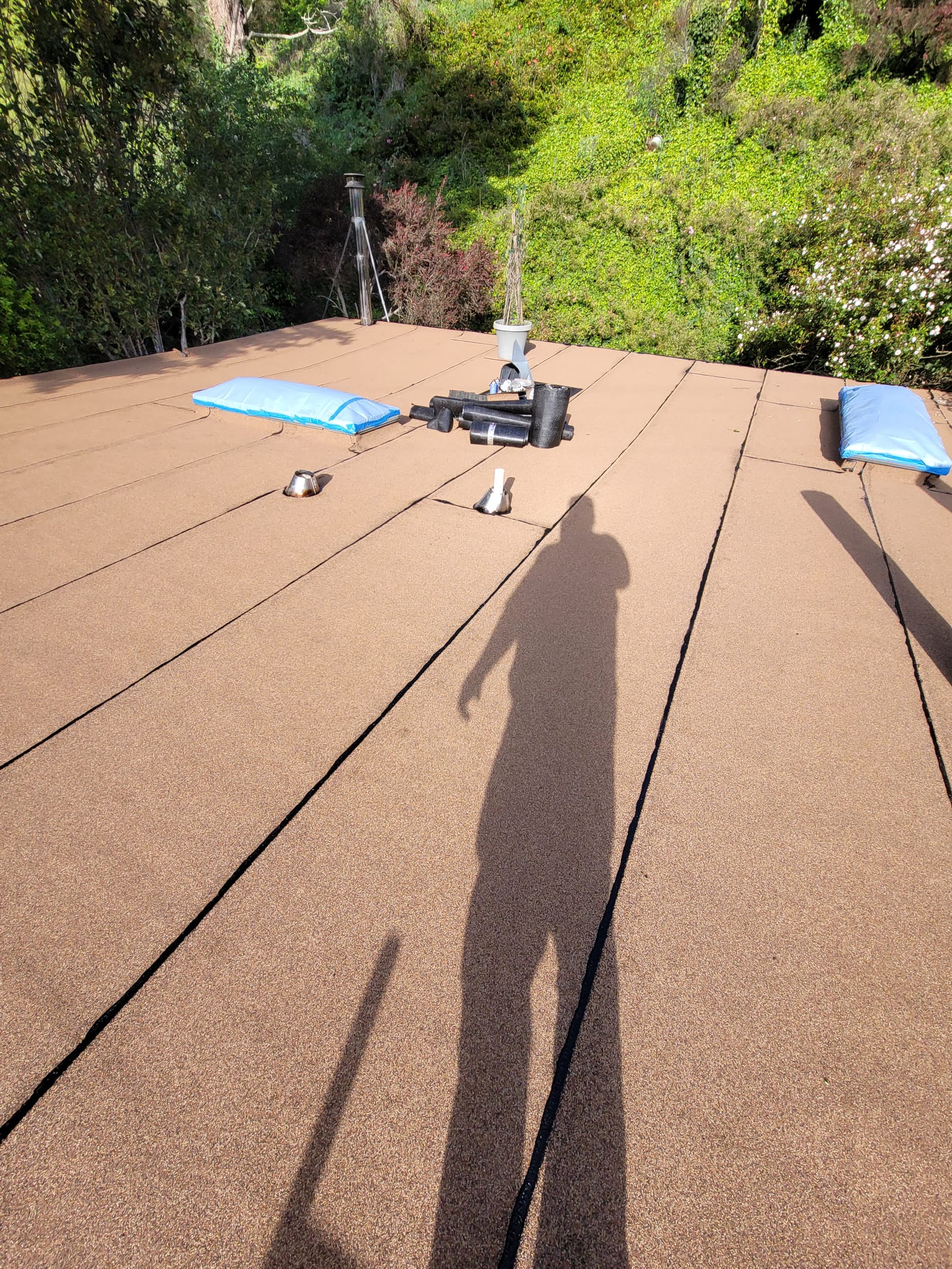
Illustrative roofing photograph from our gallery—not documentation of a specific project, location, or outcome discussed in this chapter.
Before you can make any smart decision about a commercial roof — repair it, restore it, replace it, budget for it — you need to know what kind of roof it is. Nearly every low-slope commercial roof in Northern California belongs to one of six families. Here's how to recognize each, what typically goes wrong with it, and how well it takes a restoration coating.
Built-Up Roofing (BUR): The Original Flat Roof
What it looks like: alternating layers of asphalt and reinforcing felts, usually topped with embedded gravel or a mineral cap sheet. If your roof is covered in small rocks, it's almost certainly BUR.
BUR has protected commercial buildings for over a century. Its multiple redundant layers make it forgiving, but age brings blistering, alligatoring (surface cracking that looks like reptile skin), and open seams at flashings.
Restoration outlook: good candidates when dry. Gravel-surfaced BUR requires extra preparation, but smooth and mineral-cap BUR takes silicone coatings well.
Modified Bitumen: BUR's Modern Descendant
What it looks like: rolled sheets, often with a granulated surface like a giant shingle, installed in overlapping courses. Seams are visible as parallel lines across the roof.
Modified bitumen ("mod bit") adds rubber or plastic modifiers to asphalt for flexibility. It's everywhere — offices, schools, apartments, retail. Typical failure points are seams, granule loss exposing the asphalt beneath, and cracking as plasticizers dry out.
Restoration outlook: excellent. Aged mod bit is one of the most common and most successful substrates for silicone restoration.
TPO: The White Single-Ply Everywhere
What it looks like: a smooth white (sometimes gray or tan) sheet with visible heat-welded seams, mechanically fastened or glued down.
TPO exploded in popularity for its reflectivity and cost. Quality has varied across manufacturers and generations — some TPO membranes weather well, others develop cracking and seam failures earlier than expected, especially where heat reflects off walls and equipment.
Restoration outlook: good, with proper preparation. Aging TPO can be cleaned, primed, and coated, avoiding a tear-off.
PVC: The Chemical-Resistant Specialist
What it looks like: similar to TPO — a smooth single-ply with welded seams — but often slightly glossier. Common on restaurants and food facilities because it resists grease and chemical exhaust.
PVC is durable, but older membranes lose plasticizers and become brittle, and it can shatter under impact in cold weather.
Restoration outlook: coatable with the correct primer system; adhesion testing is essential.
EPDM: The Black Rubber Roof
What it looks like: a black rubber sheet, typically with taped or glued seams rather than welded ones.
EPDM is flexible and long-lived, but its seams are its weakness — adhesive-based seams age faster than the membrane itself. Its black surface also absorbs enormous heat, driving cooling costs up.
Restoration outlook: very good, and the gains are dramatic — a white silicone coating simultaneously fixes seam vulnerabilities and converts a heat-absorbing black roof into a reflective cool roof.
SPF: Spray Foam
What it looks like: a seamless, slightly lumpy surface — foam sprayed in place, then protected by a coating.
SPF offers excellent insulation and no seams at all. But the foam must be protected from UV by its coating, and that coating is a wear item. An SPF roof whose coating has worn through degrades quickly.
Restoration outlook: SPF roofs are designed to be recoated. Periodic recoating is not a repair — it's the maintenance plan, and it can keep an SPF roof running for many decades.
Why Identification Matters
Every one of these systems ages differently, fails differently, and requires different preparation, primers, and repair details before coating. A contractor who quotes your roof without first identifying the system — and testing for trapped moisture — is guessing with your money.
McCurdy Coatings has restored all six system types across the region since 1985, from distribution centers in Stockton to industrial buildings in Oakland and tech facilities in Santa Clara.
McCurdy Pro Tip
Take ten minutes and photograph your roof — the field surface, the seams, the flashings, and around every rooftop unit. Keep the photos with the building records. When something changes, you'll have a baseline to compare against. Better yet, book a free roof audit and we'll identify your system, document its condition, and tell you exactly where it stands — free, and with no obligation.
Apply this to your building
Use this guide to prepare questions, not to self-certify a roof. Suitability, scope and warranty terms depend on the inspected roof and written system requirements.