Silicone Roof Restoration
Renew a sound commercial roof in place, when testing shows it qualifies.
The short answer
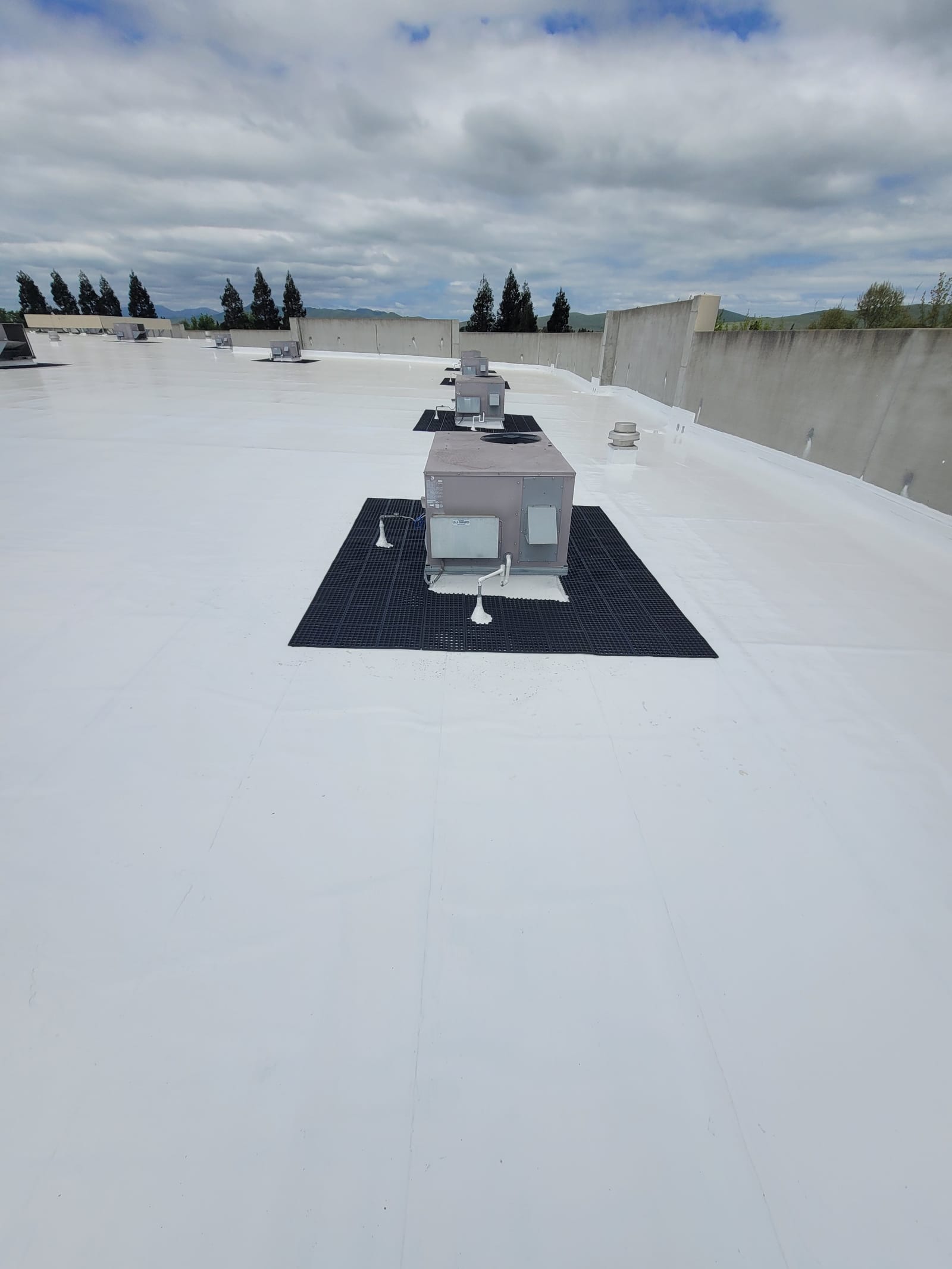
Silicone roof restoration applies a seamless, reflective silicone coating over an existing low-slope commercial roof after wet areas are removed and the roof is repaired and cleaned. It can extend the service life of a roof that is still structurally sound and mostly dry, often with less disruption and waste than tear-off. It is not a fix for a saturated or failing roof.
McCurdy Coatings has worked on commercial roofs since 1985 (CA License C-39 #477152) and serves the San Francisco Bay Area and Central Valley. Every restoration starts with an assessment; the coating is the last step, not the first.
Candid suitability
Who it fits, and who it does not
Usually a good candidate
- Low-slope or flat commercial roofs (for example single-ply, modified bitumen, built-up, metal, or SPF) that are still structurally sound.
- Roofs where moisture inside the assembly is limited and localized, so wet areas can be cut out and replaced.
- Membranes and details that can be cleaned, repaired, and shown to bond with the chosen coating through an adhesion test.
- Owners who want to add reflectivity and defer tear-off while keeping the existing roof in service.
Usually not a candidate
- Widespread wet insulation or deteriorated, soft, or rusted-through decking.
- Structural deficiencies, chronic drainage failures that cannot be corrected, or membranes that are splitting across the field.
- Substrates that fail adhesion testing or are incompatible with silicone, or roofs that will need other coatings or adhered systems over them later (silicone generally only accepts silicone recoats).
- Situations where code, insurance, or a planned building change makes replacement the more sensible scope.
Before any coating
Moisture, adhesion and drainage assessment
Moisture
Visual inspection plus non-destructive survey methods (such as infrared or capacitance scanning, where appropriate) and confirming core cuts. Wet areas are mapped and must be removed before coating.
Adhesion
Test patches of the proposed primer and coating are applied to the cleaned substrate and pulled after cure. The result guides primer selection and whether the roof qualifies at all.
Drainage
Ponding locations, drains, scuppers, and crickets are reviewed. Silicone tolerates ponding better than many coatings, but standing water is still a roof problem worth correcting where practical.
How the work goes
The restoration process
- 1
Inspection and scope
Roof walk, moisture survey, adhesion tests, photos, and a written scope describing repairs and the coating system.
- 2
Wet-area removal and repairs
Saturated insulation and failed membrane are cut out and replaced. Seams, flashings, penetrations, and drains are repaired.
- 3
Cleaning
Pressure washing and, where needed, cleaners to remove dirt, chalking, and oils so the coating can bond.
- 4
Primer and detailing
Primer if testing requires it. Seams, flashings, and penetrations are reinforced, often with fabric or detail-grade sealant.
- 5
Silicone application
Silicone is spray- or roller-applied to the thickness specified by the manufacturer for the system and warranty selected, with thickness checked during application.
- 6
Closeout
Final walk, documentation, and, when a manufacturer warranty is part of the scope, the manufacturer's inspection and warranty paperwork.
What affects price
Cost drivers
We do not publish a per-square-foot price, because the assessment findings decide most of the cost. A written proposal follows the inspection. These are the factors that move the number:
Roof size and access
Square footage, height, staging, and how materials reach the roof.
Amount of wet area
Moisture survey findings largely determine tear-out and replacement quantities.
Substrate and repairs
Seams, flashings, penetrations, and drains needing work before coating.
Specified thickness
Mil thickness, set by the manufacturer system and warranty term, drives material quantity.
Primer and reinforcement
Whether adhesion tests call for primer, and how much fabric reinforcement is specified.
Warranty type
Manufacturer warranty options carry their own requirements and fees.
Occupancy and scheduling
Working around tenants, rooftop equipment, weather windows, and operating hours.
Warranties: manufacturer warranties are conditional. They depend on the roof qualifying, the approved product system and thickness, installation by an authorized applicant where the manufacturer requires it, inspection, and fees. Ask for the specific warranty, term, and exclusions in writing.
Side by side
Silicone coating vs. replacement
| Factor | Silicone restoration | Replacement |
|---|---|---|
| What happens to the existing roof | Kept in place after repairs and wet-area removal | Removed (or overlaid where code allows) and rebuilt |
| Qualification | Depends on moisture, adhesion, and structural condition | Possible in most conditions, including wet or failed roofs |
| Disruption | Usually less noise and debris; roof stays watertight in stages | Tear-off, debris, and more exposure during the work |
| Waste | Limited to removed wet areas | Full tear-off waste unless recovered |
| Future maintenance | Periodic inspection; recoat with silicone near end of service | Conventional maintenance for the new membrane type |
| Warranty | Manufacturer coverage available only for qualifying roofs and approved installation | Manufacturer coverage per the new system's terms |
| Cost | Usually lower for a qualifying roof, but depends on the drivers listed above | Typically higher due to removal, insulation, and new membrane |
Owner questions
Frequently asked questions
Learning Center
Where we work
San Francisco Bay Area and Central Valley commercial properties.
Authoritative sources
- Cool Roof Rating Council: Rated Products Directory
- California Energy Commission: Building Energy Efficiency Standards (Title 24 Part 6)
- GE / Momentive Enduris silicone roof coatings (manufacturer literature)
- Gaco silicone roof coatings (manufacturer literature)
Manufacturer links are general product references, not a statement of certification or endorsement.
Find out whether your roof qualifies
Book an on-site assessment. If restoration is not the right scope, we will tell you.