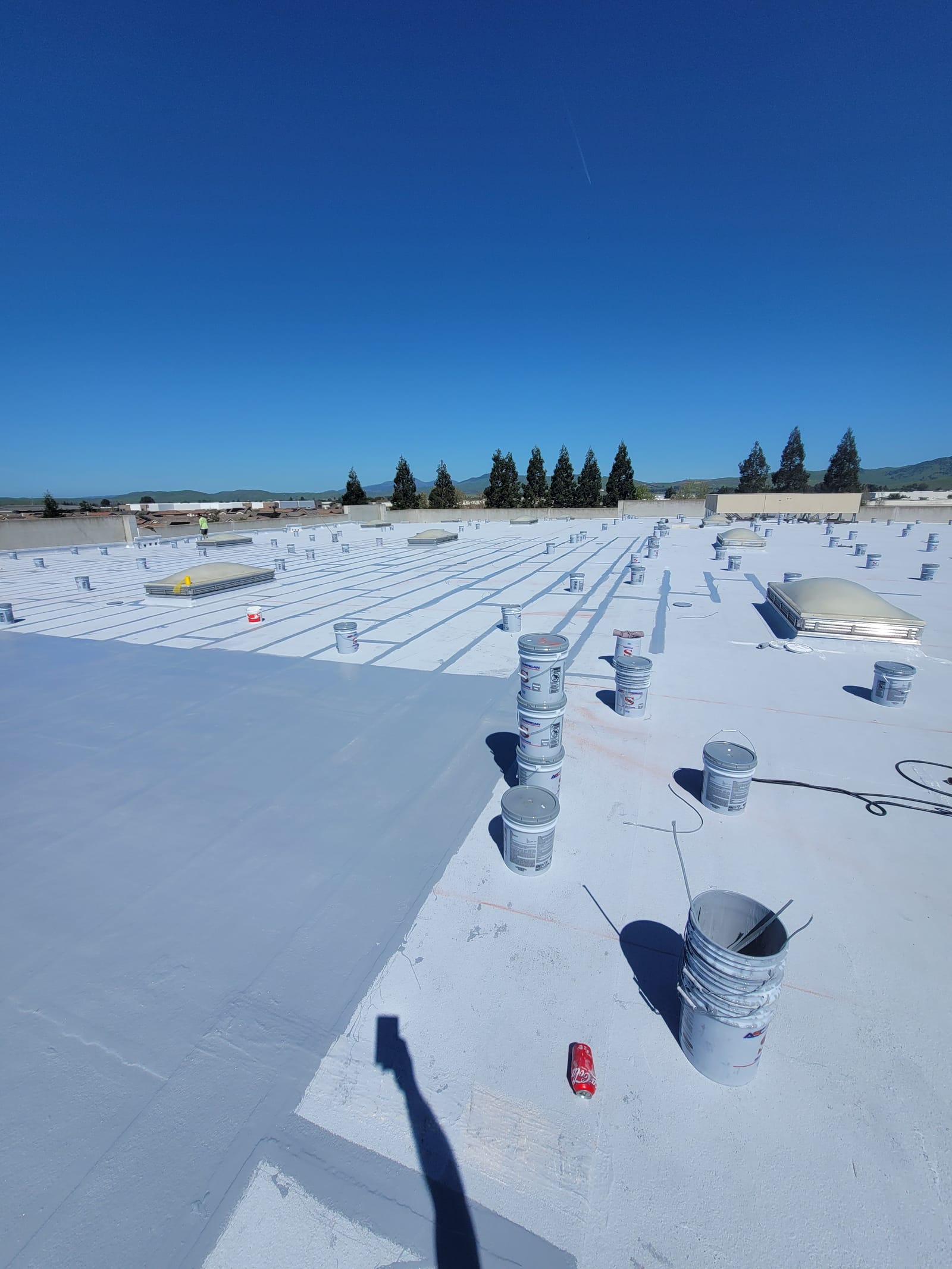
Silicone restoration
Best for: sound membrane roofs
A ponding-water-resistant, seamless membrane that renews aging low-slope roofs around drains, curbs, and penetrations.
Silicone cool roof systems engineered for the extreme heat loads and large footprints of Central Valley warehouses and logistics facilities.
50–70%
Restoration can preserve a sound roof deck without tear-off costs.
15–25%
Typical cooling-related energy reduction cited for reflective systems.
Up to 30
Manufacturer-backed warranty terms depend on the specified system.
10,094+
McCurdy's current company-wide service milestone.
System Options
The right specification depends on the existing roof assembly, moisture findings, drainage, and operating requirements. McCurdy assesses those conditions before recommending a system.
Best for: sound membrane roofs
A ponding-water-resistant, seamless membrane that renews aging low-slope roofs around drains, curbs, and penetrations.
Best for: warehouses with exposed panels
Rust treatment, fastener work, seam reinforcement, and a reflective topcoat help manage movement and heat.
Best for: insulation upgrades
A project-specific option when the roof needs added insulation, slope correction, or a seamless waterproofing layer.
Case Study
Representative Central Valley project profile
Large, active warehouse with broad low-slope roof areas, rooftop equipment, and loading operations that could not pause for a tear-off.
Plan a Similar ProjectThe challenge
Heat, ponding, and aging details were putting inventory and daily operations at risk while a full replacement would have created major disruption.
The approach
The assessment mapped moisture, repaired compromised areas, reinforced penetrations and traffic paths, and matched a high-SRI silicone system to the existing assembly.
The outcome
A documented restoration plan preserved the usable roof, reduced disruption around dock schedules, and created a maintainable path to manufacturer-backed warranty coverage.
More Building-Specific Resources
Built for High-Volume, High-Heat Operations
Warehouses present one of the most demanding roofing environments in commercial construction: vast flat decks, heavy rooftop equipment, constant foot traffic around HVAC units, and summer heat loads that drive interior temperatures up and cooling bills higher.
Silicone coatings were engineered for exactly these conditions. Unlike acrylics, silicone doesn't re-emulsify under ponding water — it stays bonded and watertight even when water sits on the roof for days. Unlike asphalt-based systems, silicone reflects rather than absorbs solar energy, reducing rooftop temperatures by 40–60°F and cutting HVAC runtime proportionally.
For a 200,000 sq ft distribution center, that temperature difference translates directly to energy savings every day the sun is up — and in Tracy, Lathrop, Stockton, and Modesto, that's a lot of days.
What We Solve
Central Valley warehouses routinely see rooftop temperatures above 170°F in July and August. Every degree of surface heat that penetrates the roof deck is BTUs your HVAC — and your workers — must cope with.
Warehouse roofs are commonly flat or nearly flat, making them prone to standing water after rain. A silicone coating's zero water-absorption characteristic is designed specifically for this condition.
HVAC condensers, exhaust fans, and solar arrays require periodic maintenance access. McCurdy's reinforced detail work protects penetrations and traffic paths so routine access doesn't compromise the membrane.
A 200,000 sq ft distribution center represents an enormous capital exposure on the roof. Silicone restoration at 50–70% of replacement cost is the financially responsible answer when the deck is otherwise sound.
Common Questions
Yes. McCurdy crews coordinate application around dock operations and peak receiving windows. Silicone coatings cure without strong solvent odors, and the application process creates no structural disruption to the building interior.
Most warehouse roofs in that size range are completed in 3–5 days of applied work, depending on surface preparation needs, penetration count, and weather. We provide a detailed schedule at the estimate stage.
McCurdy's assessment includes an infrared thermal scan to locate saturated insulation. Those sections are removed and replaced before coating — applying a new membrane over wet insulation is the single most common cause of premature coating failure, and we won't do it.
Roughly 80% of the commercial flat roofs we assess are restoration-eligible. The key factors are substrate adhesion, moisture content, and the condition of flashings and penetrations. Our free assessment gives you a definitive answer.
In the Central Valley, where cooling degree-days are high and warehouses often have minimal insulation, the energy offset is substantial. Most clients see 15–25% reductions in cooling-related energy consumption. We can provide estimated payback periods at the quote stage.
From Our Blog
McCurdy's assessment includes an infrared moisture scan and a written restoration vs. replacement recommendation — no obligation.