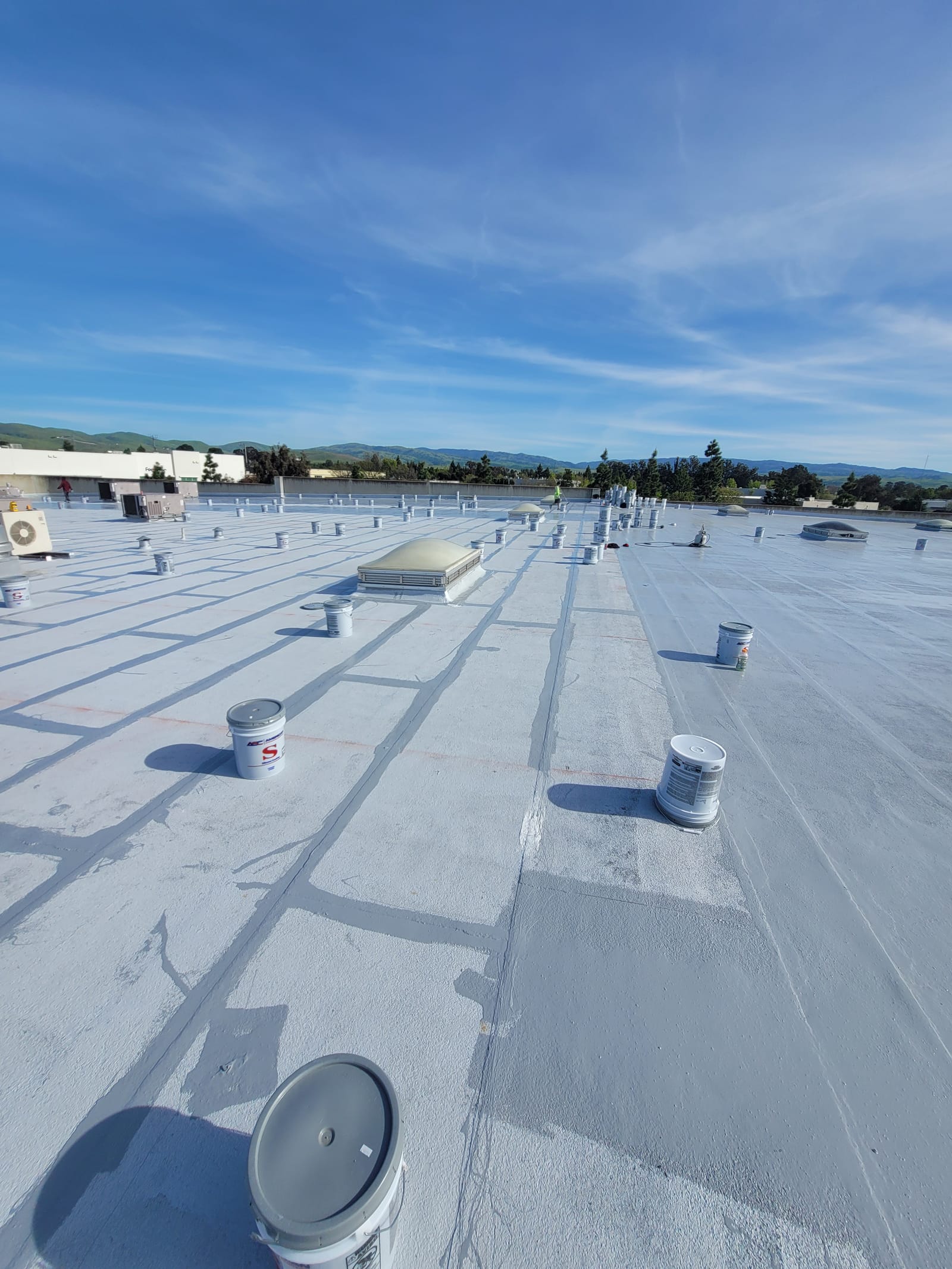
Corrugated metal restoration
Best for: packing sheds and farm buildings
Rust treatment, fastener sealing, and reinforced panel laps create a continuous reflective weather barrier.
Silicone roof coatings for packing sheds, cold storage facilities, and farm buildings — engineered for the unique demands of California agriculture.
15–25%
Reflective roof systems can reduce heat gain over cold storage and packing areas.
40–60°F
Reflective coatings reduce solar heat absorbed by dark or weathered roof surfaces.
Up to 30
Warranty terms depend on the roof assembly, preparation, and selected manufacturer system.
Zero
Eligible restoration projects are installed over the existing roof instead of sending it to a landfill.
System Options
The right specification depends on the existing roof assembly, moisture findings, drainage, and operating requirements. McCurdy assesses those conditions before recommending a system.
Best for: packing sheds and farm buildings
Rust treatment, fastener sealing, and reinforced panel laps create a continuous reflective weather barrier.
Best for: low-slope agricultural facilities
A seamless coating renews eligible existing membranes and handles the heat, moisture, and movement common in farm buildings.
Best for: refrigerated buildings
The assessment accounts for condensation, vapor drive, insulation condition, and refrigeration loads before specifying the layers.
Case Study
Representative San Joaquin Valley project profile
Agricultural cold-storage facility with a metal roof, temperature-sensitive inventory, and active loading areas.
Plan a Similar ProjectThe challenge
Thermal movement, weathered fasteners, and heat gain were increasing maintenance pressure while operations needed to keep receiving and shipping.
The approach
McCurdy's review focused on rust, panel movement, moisture, and drainage before sequencing preparation and a reflective silicone restoration around the operating schedule.
The outcome
The facility received a lower-disruption roof plan with sealed leak paths, a cooler exterior surface, and clear maintenance documentation for the property team.
More Building-Specific Resources
From Packing Shed to Cold Storage
California's agricultural buildings face a roofing environment unlike any other: blazing summer heat in the San Joaquin and Salinas valleys, metal roof systems that expand and contract dramatically with temperature swings, and cold storage facilities that must manage moisture from two directions simultaneously.
Silicone roof coatings are particularly well-suited to these conditions. Applied as a fluid and cured into a monolithic membrane, silicone seals the roof deck, panel laps, fasteners, and penetrations in a single operation — eliminating the leak paths that traditional sealant-and-patch approaches miss.
For cold storage facilities, the energy impact is immediate: lower exterior surface temperatures reduce the thermal load on refrigeration systems from the top down, cutting compressor runtime and energy consumption every day.
What We Solve
Packing sheds and farm buildings are often clad in corrugated metal — one of the hottest roof surfaces in commercial agriculture. Silicone coatings bring rooftop temperatures down by 40–60°F, protecting stored produce and reducing refrigeration loads.
Cold storage facilities face a dual moisture challenge: exterior rain and interior condensation driven by large temperature differentials. McCurdy's system design accounts for vapor drive and ensures the membrane manages moisture in both directions.
Agricultural buildings in open rural settings face sustained wind exposure. Metal panel roof systems move with thermal cycling and wind load. Silicone's elastomeric flexibility bridges panel joints without cracking under repeated movement.
Proximity to fertilizers, pesticides, and agricultural chemicals can degrade conventional roofing materials over time. Silicone chemistry is inherently resistant to a wide range of agricultural chemicals, making it a durable choice for farm structures.
Common Questions
Yes, with proper surface preparation. McCurdy treats rust and applies a penetrating primer before the silicone topcoat. Active rust must be treated or replaced, but surface oxidation is compatible with our restoration process.
The coating is applied to the exterior surface only and has no effect on interior ventilation. The primary benefit for packing facilities is reduced radiant heat gain, which improves worker comfort and produce preservation.
Silicone remains flexible to well below freezing temperatures, so it does not crack or delaminate through freeze-thaw cycling. This makes it one of the few coating systems suitable for cold storage exterior applications.
We serve agricultural buildings of all sizes. While our average agricultural project is 20,000–80,000 sq ft, we evaluate each project individually. Contact us and we'll let you know whether your building is a good candidate for restoration.
McCurdy can provide SDS sheets and product documentation for all materials used. Silicone roof coatings are applied to the exterior roof surface only and are not in contact with food products or interior air systems.
Infrared moisture scan included. McCurdy's written report tells you exactly what your packing shed, cold storage, or farm building needs.