The Real ROI of Silicone Roof Coating vs. Full Tear-Off Replacement
Run the Numbers Yourself — The Math Is Not Close
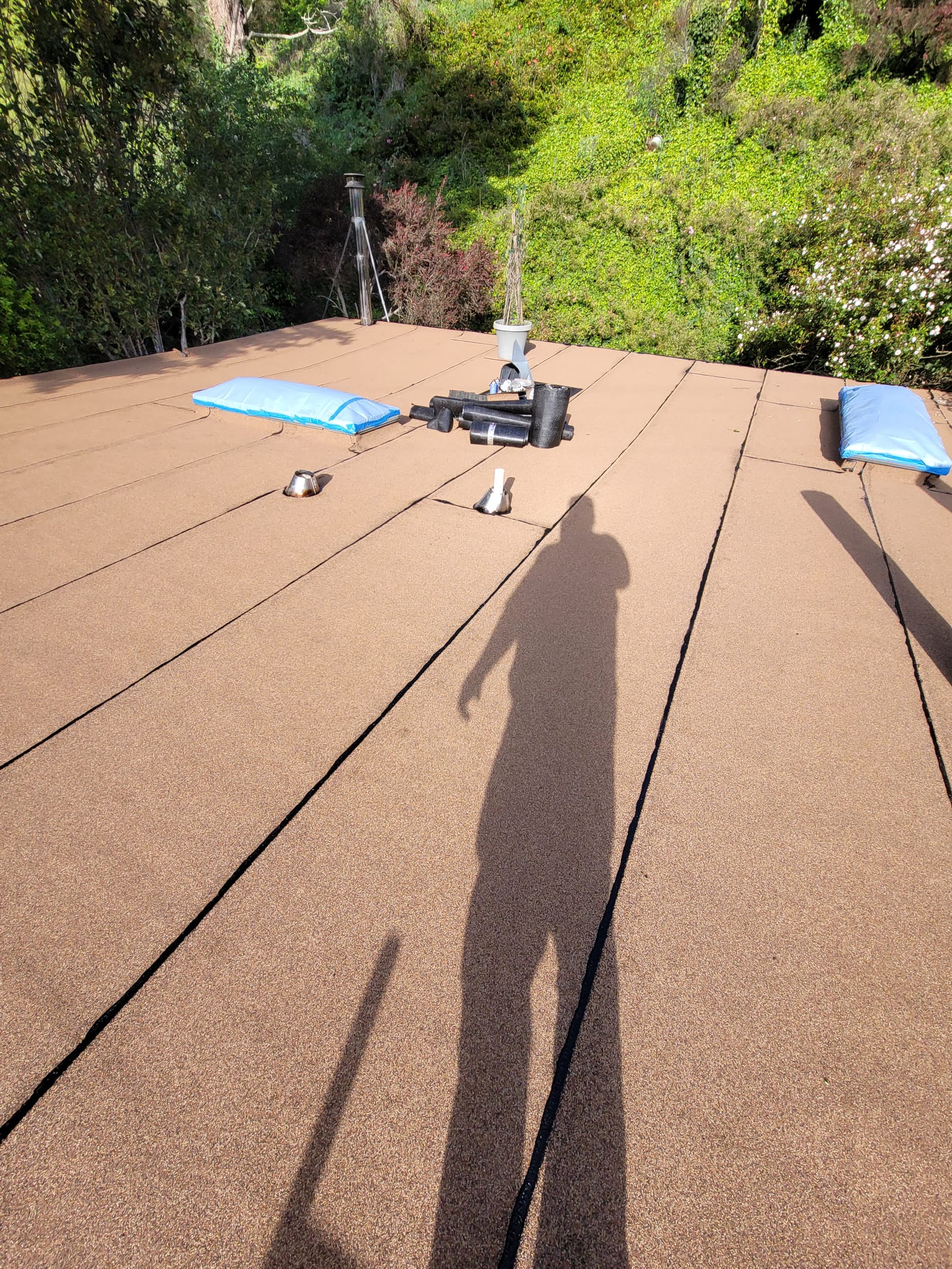
Illustrative roofing photograph from our gallery—not documentation of a specific project, location, or outcome discussed in this chapter.
Every property manager knows restoration costs less than replacement up front. What fewer appreciate is how lopsided the comparison becomes when you run the full 20-year math — energy, disruption, taxes, and the option value of deferring a tear-off.
Let's build the comparison honestly, with a worked example you can adapt to your own building.
The Worked Example: A 50,000 SF Warehouse
Take a 50,000 square foot warehouse with an aging modified bitumen roof that's structurally sound but leaking at seams — a classic restoration candidate. Realistic California numbers:
- Silicone restoration (20-year NDL system): roughly $5/SF → $250,000
- Full tear-off and replacement: roughly $16/SF → $800,000
Upfront difference: $550,000. But that's only the beginning.
Factor 1: Energy Savings Start Immediately
A white silicone cool roof typically cuts cooling costs 15–25% (McCurdy customers average around 20%). If this warehouse spends $40,000 a year on cooling, that's roughly $8,000 per year — about $160,000 over 20 years, before any utility rate increases. A new dark-surfaced replacement roof captures none of this; a new white membrane captures some, but you paid triple to get it.
Factor 2: Business Disruption
Tear-off means weeks of noise, debris, odors, dumpsters, crane lifts, and sections of the building exposed to weather between demolition and dry-in. For tenanted buildings, it can mean rent concessions; for operating businesses, lost productivity.
Restoration is quiet by comparison — no demolition, no exposure, work phased around your operations. For most buildings the occupants barely notice. Assigning a dollar value is building-specific, but for an operating facility it is rarely less than tens of thousands.
Factor 3: Tax Treatment
Tax treatment is scope- and taxpayer-specific. Qualifying repairs may be currently deductible, while capital improvements may need to be depreciated or may qualify for a Section 179 election under applicable rules and limits. A replacement is not automatically limited to 39-year depreciation, and a coating project is not automatically a repair. Ask your tax professional to compare the actual itemized scopes before counting tax savings in your decision. IRS Publication 946 explains relevant depreciation and Section 179 rules.
Factor 4: The Option Value of Waiting
Here's the strategic point: coating now doesn't eliminate the option to replace later — it defers it 15–30 years, with a No Dollar Limit warranty protecting you the entire time. Money not spent on a tear-off today can work elsewhere in your portfolio. And a renewable coating system can often be recoated at the end of its term for far less than the original application, pushing replacement out again.
Replacement, by contrast, spends the entire capital sum immediately to buy roughly the same watertight outcome the coating delivers.
The 20-Year Scorecard
For our example warehouse:
- Restoration path: $250,000 upfront, minus ~$160,000 energy savings, minimal disruption, potentially expensed — net economic cost in the low six figures
- Replacement path: $800,000 upfront, weeks of disruption, depreciated over decades — net economic cost several times higher
Both paths end with a watertight, warrantied roof. One of them leaves half a million dollars or more working elsewhere.
When Replacement Really Is the Right Answer
Honesty requires the flip side: if moisture surveys show saturated insulation across the roof, if the membrane is broadly failed, or if the deck is compromised, coating is the wrong move and no ROI math changes that. That's precisely why the process starts with an audit, not a quote. We make this call every week for owners from Fremont to Tracy to Burlingame — and when the answer is "replace," we say so.
McCurdy Pro Tip
Run this math for your own building: (replacement quote − restoration quote) + (annual cooling spend × 20% × 20 years) + your honest estimate of disruption cost. That total is what restoration keeps in your pocket — if your roof qualifies. There's one free way to find out: book a McCurdy roof audit. Since 1985, over 10,094 services and 1,000,000+ square feet coated, backed by NDL warranties up to 30 years with zero unresolved claims.
Apply this to your building
Use this guide to prepare questions, not to self-certify a roof. Suitability, scope and warranty terms depend on the inspected roof and written system requirements.